
How Long Should a Bedtime Story Be? A Parent's Guide by Age
A practical guide to bedtime story length by age, with realistic reading-time ranges, signs a story is too long, and ways to keep storytime calm without rushing.
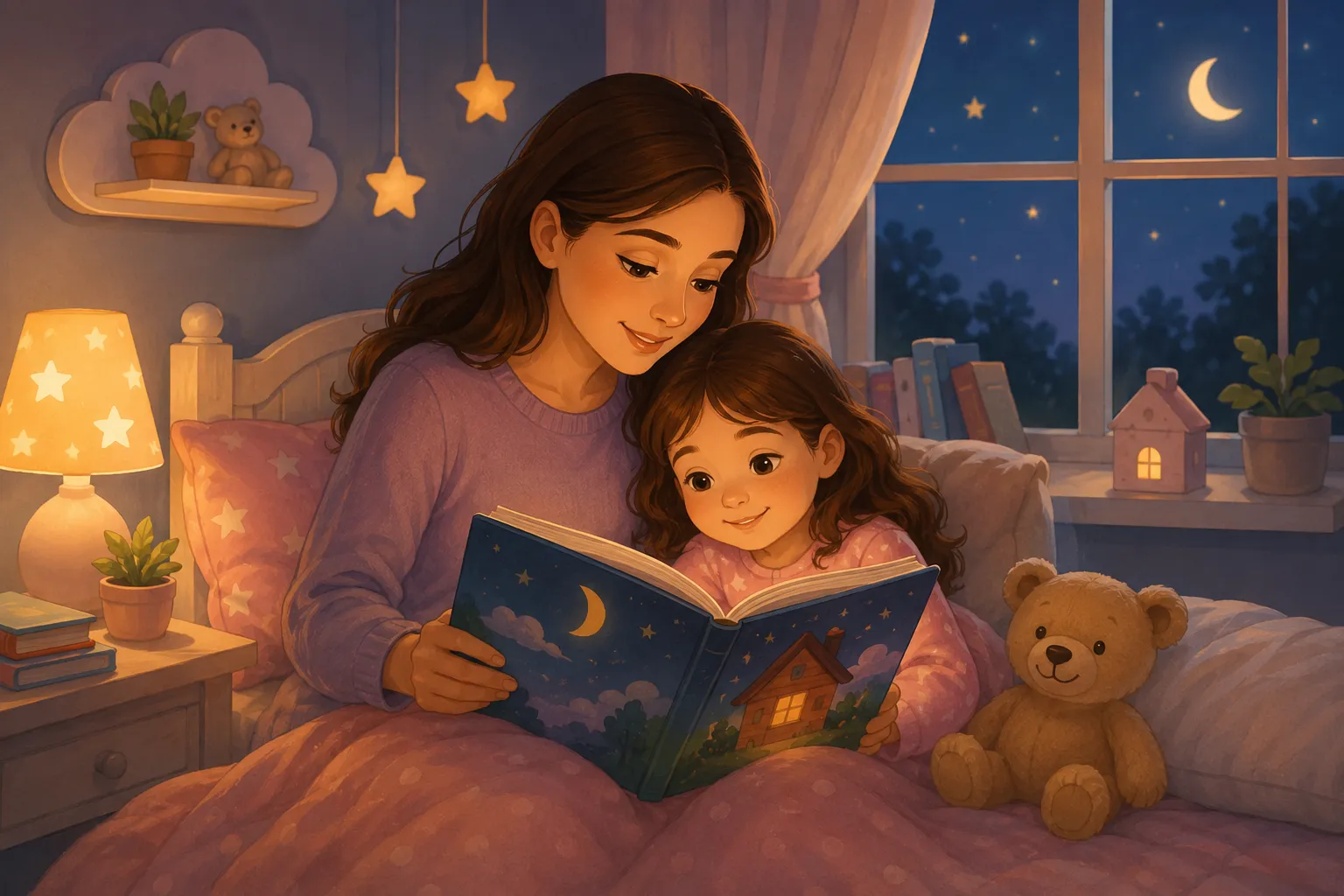
Choose a bedtime story your child can enjoy within the time available before lights-out. There is no single correct duration: attention, interest and the rest of the routine matter more than finishing a particular book.
As a practical starting point, you might plan 5–20 minutes, then shorten or extend it to fit your evening. The ranges below are editorial planning suggestions, not medical targets or measured averages for children of each age.
Bedtime story length by age
Ages 2 to 3: about 5 to 10 minutes
Toddlers do not need a long plot to benefit from being read to. At this age, repetition is often more important than length. A short story read slowly, with time to point at pictures or repeat favorite lines, can hold attention better than a longer book read quickly.
If your child asks for the same story again, that does not mean the first reading was too short. Familiar stories help young children predict what comes next, notice words they recognize and participate in the reading.
On a difficult night, even five calm minutes can be enough to preserve the bedtime pattern: book, cuddle, goodnight.
Ages 4 to 5: about 10 to 15 minutes
Preschoolers can usually follow a more complete beginning-middle-end story, but bedtime is not the best moment to test the outer limit of their attention span.
Ten to fifteen minutes gives enough room for a satisfying story while leaving space for the small interruptions that make shared reading useful: a question about a character, a new word, or a prediction about what happens next.
This age also brings more bedtime negotiation. If “one more story” is becoming a nightly argument, decide the limit before reading begins. One medium-length story often works better than an open-ended promise to read until somebody feels sleepy.
If the whole evening has become unpredictable, our guide to a calm bedtime routine for ages 4 to 6 focuses on keeping the sequence consistent rather than chasing an exact clock time.
Ages 6 to 8: about 15 to 20 minutes
Early readers can enjoy longer plots, short chapter books and stories with more description. This is also the age when storytime can start doing two jobs at once: winding down for sleep and reinforcing the idea that reading is enjoyable rather than another assignment.
Fifteen to twenty minutes is often enough to enter a story without making the reading session feel endless. If your child is reading some of the text aloud, expect the same number of pages to take longer. That is fine. Do not rush them simply to reach the end of a chapter.
If they are tired, you can alternate: they read a paragraph or page, then you take over. The goal at bedtime is not to prove independence. It is to protect a positive relationship with reading.
For more on that difference, see how bedtime stories build early reading confidence.
The right story length is the one that fits the routine
A bedtime story does not happen in isolation. It sits inside teeth brushing, pajamas, toilet trips, water requests, cuddles and all the other small negotiations at the end of a day.
That means a twenty-minute story can feel calm in a forty-minute routine and impossible in a twenty-five-minute one.
Instead of asking only how long the story should be, work backwards from lights-out.
If you want lights out at 8:00 and your child normally needs 10 minutes after the story for a cuddle and goodnight, the story needs to end around 7:50. If you begin reading at 7:35, you have a natural 15-minute limit without needing to announce a timer.
This is usually easier for children than stopping halfway through because the clock suddenly says bedtime.
Signs a bedtime story is too long
Longer is not automatically better. Reading aloud supports language, vocabulary and comprehension, but those benefits do not require pushing through a child who has stopped engaging.
A story is probably too long for that particular night if your child starts doing several of these things:
- repeatedly leaving the bed or reading spot;
- interrupting mainly to delay the ending rather than talk about the story;
- losing track of what just happened;
- becoming silly, loud or physically restless as tiredness increases;
- asking when the book will finish;
- struggling to settle once the story finally ends.
The answer is not necessarily a shorter book forever. Try the same book earlier in the evening, split it across two nights, or stop at a natural chapter break.
Children’s attention changes with hunger, activity, school, illness and simple exhaustion. A child who loves twenty-minute stories on Saturday may only have seven good minutes left on Tuesday.
What if a short story feels too short?
Parents sometimes worry that five or ten minutes “doesn’t count.” It does.
Shared reading is valuable partly because books expose children to language they may not hear in ordinary conversation, and because talking about a story gives them chances to explain, predict and connect ideas. You do not need a long session to do that.
One useful question can add more value than five hurried pages. Try asking, “What do you think happens next?” or “Why do you think she did that?” and then keep reading.
If your child enjoys talking after the story, we have a separate list of questions to ask after a bedtime story that keeps the conversation light rather than turning it into a quiz.
Should you stop when your child falls asleep?
Yes. Finishing the book is not the goal.
If your child falls asleep while you are reading, there is no prize for reaching the final page. Mark the place and stop. The ending will still be there tomorrow.
The same principle applies to narrated stories. Playback should have a clear ending rather than rolling automatically into another story. A predictable stop helps keep audio inside the bedtime routine instead of letting it become background entertainment for the next hour.
TuneTales is designed around that kind of read-and-listen experience: stories can be followed word by word, and playback ends with the story rather than continuing into an endless feed. You can see how the reading and narration features work.
What if your child always asks for one more story?
“One more” is often about connection as much as content. The child is asking to extend the part of bedtime where a parent is close, attention is undivided and nothing else needs doing.
You do not have to solve that by reading indefinitely.
Set the expectation before you begin: “Tonight we have time for one long story” or “You can choose two short stories.” A visible limit feels less arbitrary than deciding after each ending.
Another option is to separate story time from goodnight time. When the story ends, close the book but keep the final cuddle or conversation. That makes it clear that ending the story does not mean abruptly ending closeness.
A simple starting point for tonight
If you want one practical answer, try this:
- ages 2 to 3: start with 5 to 10 minutes;
- ages 4 to 5: start with 10 to 15 minutes;
- ages 6 to 8: start with 15 to 20 minutes.
Then watch your child rather than the clock. If they are still absorbed and bedtime is on track, keep going. If attention is disappearing or tiredness is turning into chaos, stop earlier tomorrow.
For a short option, The Tortoise and the Hare works well when you want a complete tale without a long commitment. The Ant and the Dove is another gentle choice centered on kindness and helping others.
The best bedtime story is not the longest one. It is the one that leaves your child wanting to come back to stories tomorrow night.