
The Boy Who Cried Wolf
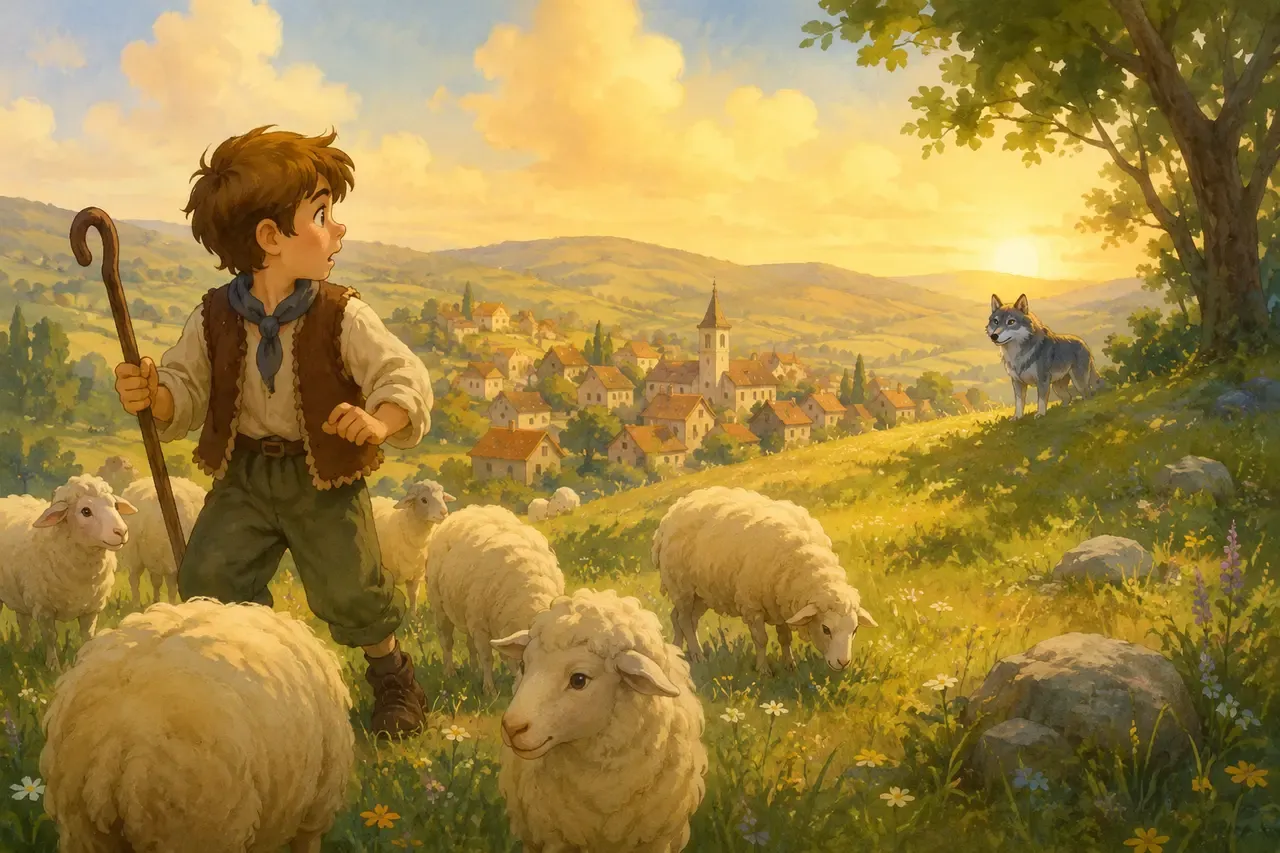
Long ago, a young shepherd named Milo lived in a village surrounded by green hills.
Every morning, Milo opened the wooden gate beside his family’s cottage and led the village sheep up a winding path. At the top of the hill, the grass grew thick and sweet. The sheep could graze while Milo watched over them.
It was an important job.
“Keep the flock together,” his mother reminded him. “And if a wolf comes near, call for help. The villagers will hear you from the fields below.”
Milo nodded. He carried a crooked wooden staff, a small lunch and a whistle tied around his neck.
At first, he liked being trusted with the flock. He counted the sheep as they wandered between the wildflowers. He found cloud shapes in the sky. He even made up names for three lambs that always followed one another.
But by midday, the clouds had drifted away, his lunch was finished and the sheep had stopped doing anything interesting.
Milo sighed.
“Nothing ever happens up here.”
A mischievous idea
From the hill, Milo could see the villagers working below. The baker carried flour into her shop. Two farmers repaired a fence. Milo’s mother hung washing beside their cottage.
Then a mischievous idea popped into his head.
He jumped onto a rock, cupped his hands around his mouth and shouted, “Wolf! Wolf! A wolf is after the sheep!”
His voice rolled down the hillside.
At once, the farmers dropped their tools. The baker hurried from her shop with flour still on her apron. Milo’s mother came running along the path. Everyone climbed the hill as quickly as they could.
But when they reached the flock, the sheep were nibbling grass peacefully. There was no wolf anywhere.
Milo burst out laughing.
“You should have seen how fast you ran!”
The villagers did not laugh.
“We came because we believed you,” said the baker, catching her breath.
“Calling for help is not a game,” said one of the farmers.
Milo’s mother looked disappointed. “A warning only works when people can trust it.”
Milo promised not to do it again.
The villagers returned to their work, and the hillside grew quiet.
The second alarm
The next day began much like the first.
Milo led the flock uphill. The sheep grazed. The sun crossed the sky. A grasshopper landed on Milo’s shoe and sprang away.
By afternoon, Milo was bored again.
He remembered all the villagers rushing up the path. He knew they had told him not to fool them, but the trick had made the dull hill exciting.
“Just once more,” he whispered.
He climbed onto the same rock.
“Wolf!” he shouted. “Please help!”
Once again, the villagers came running. Not quite as many came this time, and they did not run quite as fast.
Once again, there was no wolf.
Milo tried to hide his smile, but he could not.
“Another trick?” asked the baker.
The farmer shook his head. “Every false alarm makes the next warning harder to believe.”
Milo’s mother did not say anything. She simply looked at him for a long moment before walking back down the hill.
Milo’s smile disappeared.
For the rest of the afternoon, even the sunshine felt less warm.
A real wolf
On the third day, Milo decided he would behave differently.
He counted the sheep twice. He guided a wandering lamb back to the flock. When boredom crept in, he practised playing short tunes on his whistle.
As the sun began to sink, a rustle came from the trees.
Milo stopped playing.
At first, he saw only shadows between the trunks. Then a gray wolf stepped into the meadow.
The wolf lowered its head and watched the sheep.
The flock pressed close together.
This was no game.
Milo’s heart thumped. He waved his staff, blew his whistle and shouted with all his strength.
“Wolf! A real wolf! Please help us!”
Down in the village, people heard him.
The baker paused beside her oven.
“Milo is playing another trick,” she said.
The farmers heard the call too, but one continued stacking hay and the other kept mending the fence.
“He fooled us twice,” they said. “We will not race up the hill again.”
Milo called until his throat hurt, but nobody came.
The wolf moved closer.
Milo knew he could not fight it, so he remembered what the shepherds had taught him. He gathered the sheep tightly, made himself look as large as he could and struck his staff against a hollow log.
Bang! Bang! Bang!
The sheep bleated. Milo blew sharp notes on his whistle. Startled by the noise, the wolf stopped. Then it turned and slipped back into the trees.
Milo quickly led the frightened flock down the hill.
Trust must be rebuilt
When the villagers saw the sheep crowding through the gate, they understood that something truly had happened.
Milo told them about the wolf. He did not boast about scaring it away. He did not blame anyone for staying in the village.
“You did not come because I taught you not to believe me,” he said. “I am sorry.”
His mother put a hand on his shoulder.
“Telling the truth now is the first step,” she said. “But trust takes time to build and only a moment to damage.”
The next morning, one of the farmers walked with Milo to check the edge of the forest. Together they repaired a gap in the fence and hung small bells near the path.
Milo returned to the hillside each day.
When a lamb wandered, he told the farmer exactly where he had found it. When a storm cloud appeared, he gave a careful warning. When nothing happened, he did not invent excitement.
Little by little, the villagers learned that Milo’s words could be trusted again.
And Milo learned something he never forgot: a lie may get everyone’s attention for a moment, but honesty is what makes people listen when the truth really matters.
If you enjoyed this fable, try The Tortoise and the Hare next, or use these questions to ask after a bedtime story to talk about Milo’s choices together.