
The Crow and the Pitcher
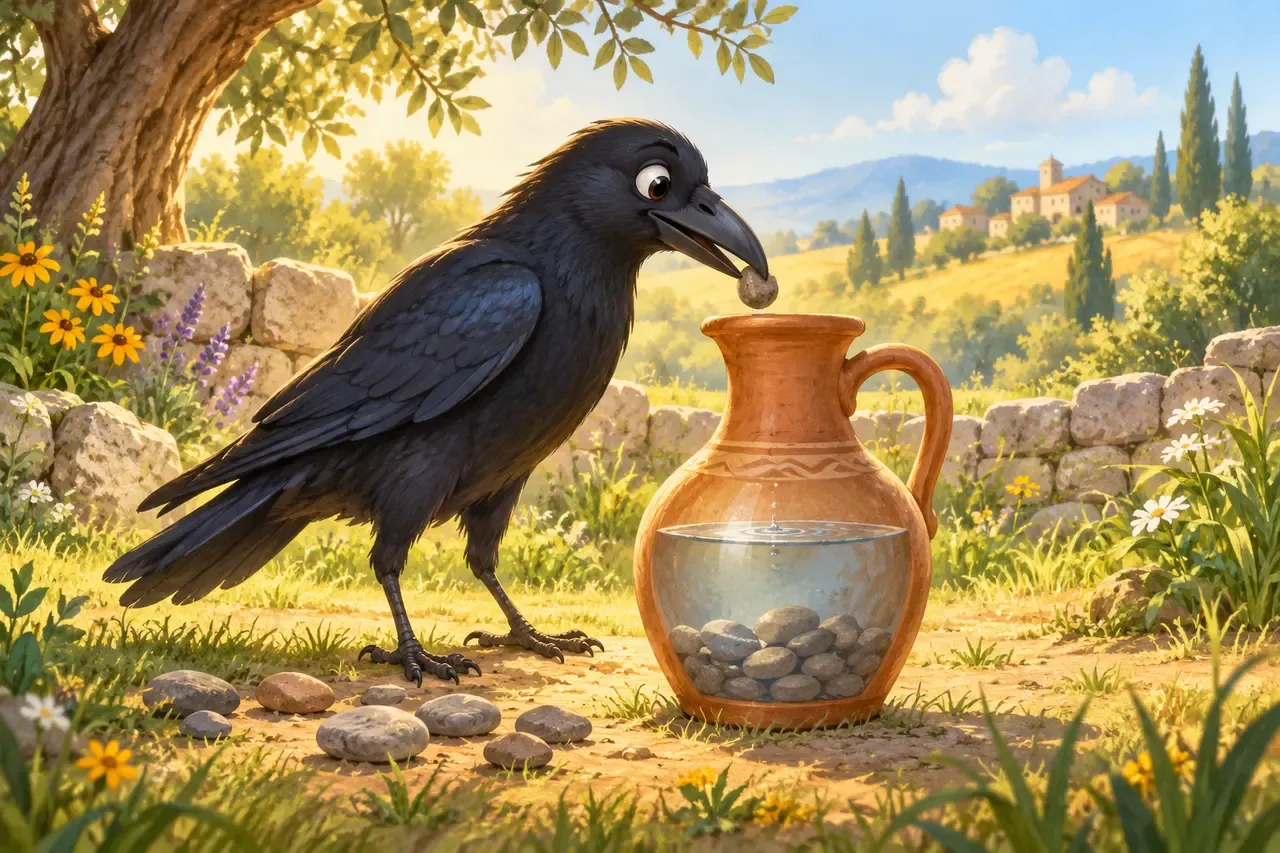
The summer sun had been shining for many days. It warmed the fields, brightened the stone walls and turned every puddle into a patch of dry earth.
High above the fields flew a young crow named Corin. He had spent the morning searching for water. He checked the stream beside the willow tree, but only a few damp stones remained. He visited the old fountain in the village square, but its bowl was empty.
“Just one cool sip,” Corin said. “That is all I need.”
He flew on, keeping his eyes open for the sparkle of water.
At last, something flashed in a garden below. Corin folded his wings and glided down beside a low stone wall. There, beneath an olive tree, stood a tall clay pitcher.
Corin hopped onto its rim and peered inside.
Water!
There was not much, but it was clear and cool. It rested at the very bottom of the pitcher.
Corin reached his beak through the narrow opening. He stretched his neck as far as it would go. The tip of his beak came close to the water—but not close enough.
A problem that would not budge
Corin tried standing on his toes. He leaned farther into the pitcher until his tail feathers pointed straight at the sky.
Still, he could not reach the water.
He stepped back and studied the pitcher.
“Perhaps I can tip it over,” he thought.
Corin pressed one wing against the clay and pushed. The pitcher did not move. He braced both feet against the ground and pushed again.
Nothing.
The pitcher was heavy, and its round base sat firmly in the earth.
Corin fluttered to the wall and looked at it from above. He thought about flying away. Somewhere beyond the hills, there might be a pond or a shaded well.
But the afternoon was growing hotter, and Corin was tired. Water was right in front of him. He simply needed a way to reach it.
“I have tried stretching,” he said. “I have tried pushing. What else can I try?”
That question felt better than saying, “I cannot do it.”
One small idea
As Corin paced beside the pitcher, his claw bumped a pebble. It rolled across the ground and tapped the clay with a tiny click.
Corin stopped.
He picked up the pebble in his beak and dropped it into the pitcher.
Plink!
The pebble fell through the water and settled at the bottom.
Corin peered inside. The water looked almost the same, yet he thought it might have risen the smallest bit.
He found another pebble and dropped it in.
Plink!
Then another.
Plink!
This time Corin was certain. The water had moved higher.
His tired eyes brightened. “The pebbles are taking up space,” he said. “If I add enough, perhaps the water will come to me.”
He searched the garden for stones small enough to fit through the pitcher’s neck. Some were too wide. Some were so light and dusty that they would not help much. Corin chose smooth, solid pebbles and carried them over one at a time.
Plink. Plink. Plink.
The water rose slowly.
A little progress still counts
After ten pebbles, Corin looked inside. The water was higher, but his beak still could not reach it.
“This is taking too long,” he groaned.
He sat in the shade and rested his wings. For a moment, the task seemed just as impossible as before.
Then Corin noticed something important. When he had first arrived, he could barely see the water in the dark bottom of the pitcher. Now sunlight shimmered on its surface.
The idea was working.
It was simply working one small step at a time.
Corin remembered the steady tortoise from The Tortoise and the Hare, who did not need to be the fastest to keep moving toward the finish.
“One pebble is not enough,” Corin said, standing again. “But one pebble after another might be.”
He carried five more stones. Then five more. Each trip was short, and each pebble made a quiet splash.
When his beak grew tired, he rested. When a stone was too large, he left it and chose another. When he lost count, he did not begin counting again. The number did not matter. The rising water did.
Soon the pebbles formed a little hill inside the pitcher, and the water climbed around them.
The water rises
At last, Corin dropped in one final pebble and looked over the rim.
The water was close enough.
He lowered his beak and drank.
The first sip was cool and wonderful. Corin drank slowly until his thirst was gone. Then he sat beneath the olive tree, feeling the breeze ruffle his feathers.
A sparrow landed on the wall and stared at the pitcher.
“Did you move that heavy pot by yourself?” she asked.
“No,” said Corin.
“Did you break it open?”
“No.”
“Then how did you reach the water?”
Corin showed her the pebbles resting inside.
The sparrow tilted her head. “You must be very strong to carry so many.”
Corin smiled. “I was not strong enough to move the pitcher. I only had to be patient enough to think of a different way.”
Before he left, Corin placed a broad leaf over part of the opening so the hot sun would not warm the remaining water too quickly. The sparrow took a sip, too.
Then Corin lifted his wings and flew toward home. The fields below were still dry, and the sun was still bright. Those things had not changed.
But Corin had.
Whenever he met a hard problem after that day, he did not decide at once that it was impossible. First he paused. He looked carefully. He tried a new idea. And if the idea worked only a tiny bit, he kept going.
For Corin knew that a small step could lead to the next small step—and enough small steps could bring what seemed far away within reach.
The moral of the story
When strength alone cannot solve a problem, careful thinking can show another way. Patience and small, steady steps can turn a difficult task into one you can finish.
Corin’s response to frustration is very different from the fox’s reaction in The Fox and the Grapes: instead of pretending the thing he wants does not matter, he pauses, tests an idea and learns from what happens.