
Why Does My Child Want the Same Bedtime Story Every Night?
Repeating the same bedtime story is common and useful. Learn why children love familiar books and how to add variety without turning bedtime into a battle.
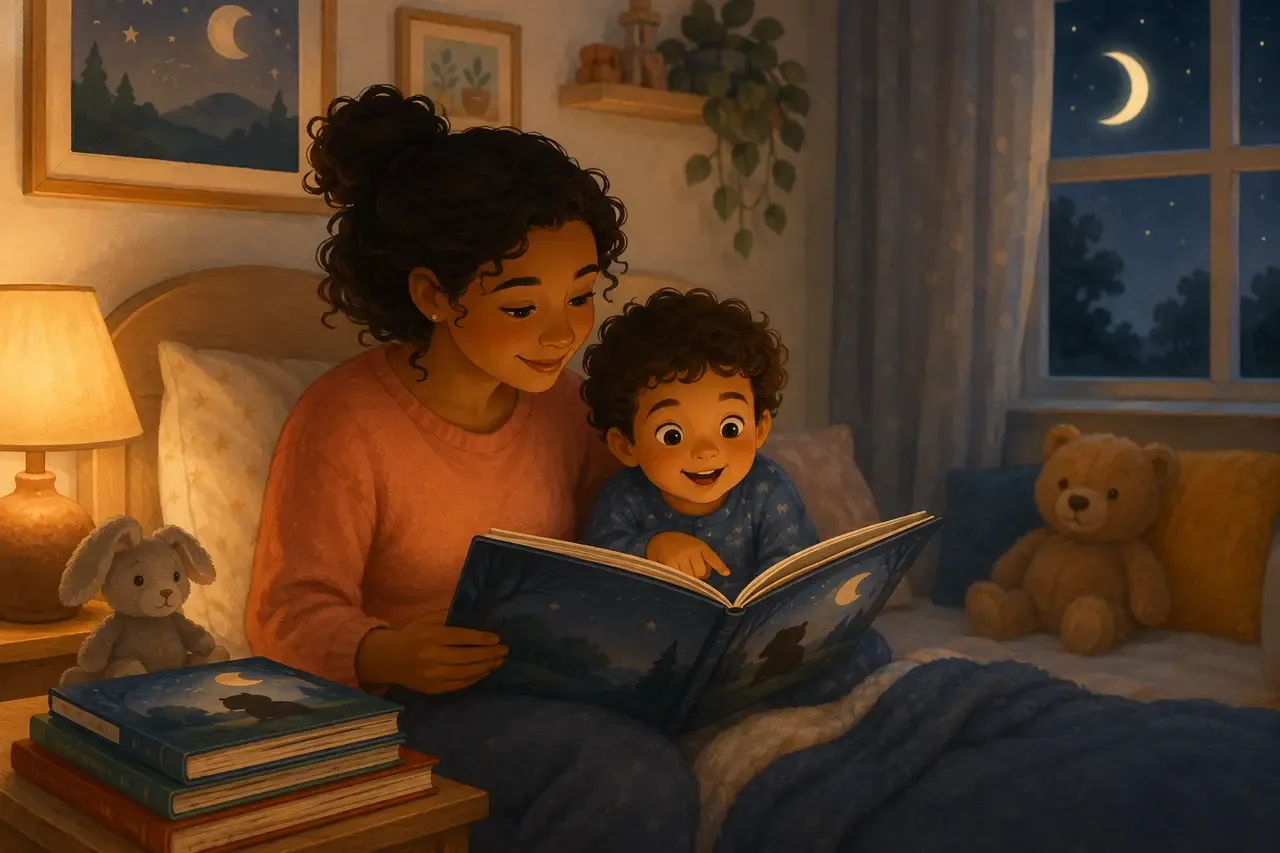
A familiar bedtime story offers predictable words, a known ending and a choice your child controls. Repeating it can also give them more chances to notice details and join in. Wanting the same book does not, by itself, mean a child lacks curiosity.
You can respect the favorite while offering something new occasionally. The suggestions below explain ways to share repeated stories and widen the choice without turning bedtime into a negotiation.
Familiar stories make room for learning
The first time children hear a story, much of their attention goes to following what happens. Who is this character? Where are they going? Is that noise important? What will happen next?
On the next reading, the plot is no longer completely new. Children can notice a repeated phrase, study an illustration, connect a word with a picture or anticipate a character’s decision. Each return gives them another chance to assemble the story.
In a study of 3-year-olds, children who heard the same stories repeatedly learned more of the unfamiliar words than children who encountered those words across different stories. The researchers did not show that only one book should be read forever. They showed that repetition can give young learners useful additional encounters with the same language (Horst, Parsons and Bryan, 2011).
That is why a child may begin by listening quietly, then point to details, finish a repeated line or correct you when you skip a page. These are signs of growing familiarity and participation, not evidence that the book has stopped teaching them anything.
Predictability feels good at bedtime
Bedtime involves many transitions. Play stops. The room becomes quieter. A parent may leave after goodnight. For a young child, knowing exactly what comes next can make that sequence easier to understand.
A favorite story has no surprises. The difficult character is resolved in the same way. The funny page arrives at the expected moment. The final sentence always leads toward goodnight.
The book is not a guaranteed sleep treatment, but it can act as a familiar cue inside a consistent routine. The American Academy of Pediatrics’ Brush, Book, Bed guidance recommends a simple nightly sequence: brush teeth, read a favorite book or two, then go to bed at a regular time.
Notice the word favorite. A useful bedtime book does not need to be novel. At this point in the day, predictability may be part of its appeal.
Repetition gives children a little control
Young children live in a world where adults decide most of the schedule. Choosing the bedtime story is a safe, limited decision they can make for themselves.
When a child says, “That one again,” the request may be about the story, but it can also mean:
- I know what is about to happen;
- I am good at joining in with this book;
- this is how our bedtime goes;
- I want to make one decision before the day ends;
- I like sharing this particular moment with you.
Offering an acceptable choice can preserve that sense of control without letting bedtime expand indefinitely. Try, “Would you like the fox story or the tortoise story?” rather than opening the whole shelf when everyone is tired.
How many times is too many?
There is no standard number after which rereading becomes harmful. If the book is age-appropriate, your child remains engaged and the routine works for the family, repetition itself is not a problem.
You can look at the broader pattern instead of counting readings. Does your child encounter other language and ideas during the week—through conversation, play, songs, library visits or daytime books? Are they enjoying the story rather than becoming distressed by small changes? Can the family keep bedtime within a reasonable boundary?
The same favorite at night can sit alongside variety elsewhere. You do not have to make one bedtime book responsible for your child’s entire reading diet.
If a rigid ritual causes intense distress, interferes significantly with daily life or comes with other developmental concerns, discuss the wider pattern with your child’s pediatrician or another qualified professional. A repeated favorite by itself, however, is usually a normal reading preference.
Make the familiar book feel fresh
You can change the way you share a book without changing the book itself. Keep the experiment light; bedtime does not need to become a lesson.
Let your child supply the repeated line
Pause before a phrase they know well. Give them time to say it, make the sound or point to the matching picture. Joining in turns listening into a shared performance.
Notice one new detail
Choose a single illustration and ask, “What did you notice tonight?” You might find a tiny object in the background, follow a color across several pages or wonder how a character feels.
Our guide to questions to ask after a bedtime story has more prompts, but one gentle question is enough at bedtime.
Change one voice, not the whole routine
Read one character in a whisper or let your child choose whether a line should sound sleepy, surprised or proud. Small variations preserve the security of the story while inviting playful attention.
Invite retelling
Ask your child to “read” a page from memory or tell the story to a toy. They do not need exact words. Retelling shows which events and feelings they understand.
Connect the story to real life
If a character waits patiently, helps a friend or admits a mistake, briefly recall a similar moment from your child’s day. Keep the connection warm and curious rather than turning the story into a lecture.
Add variety without a bedtime battle
If you need a break from the favorite book, sudden removal is rarely the only option. Try a predictable rule that leaves room for both comfort and discovery.
Use “one familiar, one new”
Read the favorite first and then offer a short new story, or reverse the order if knowing the favorite comes last helps your child settle. Keep the total reading time within the boundary you already use.
If bedtime is getting too long, our guide to how long a bedtime story should be offers flexible starting points by age.
Rotate a very small selection
Place two or three books where your child can reach them and change one book every few days. A small selection feels manageable, while a completely different shelf each night can make choosing harder.
Find a related story
Move sideways from what your child already loves. If animals are the attraction, try another animal tale. If they enjoy predicting a repeated pattern, choose a story with a similar rhythm. A child who enjoys persistence in The Tortoise and the Hare might next enjoy the problem-solving and feelings in The Fox and the Grapes.
Keep new books for daytime first
A child may be more open to an unfamiliar story when they are rested. Read it at breakfast, after nursery or during quiet play. Once it becomes familiar, add it to the bedtime choices.
Be honest when you need a change
Parents are allowed to have limits. You can say, “I know you love this one. Tonight I can read it once, and tomorrow we can read it again.” A calm boundary is kinder than reading resentfully through several extra rounds.
Should you read every word exactly the same way?
No. Children often enjoy consistency, but shared reading does not require a perfect performance.
You can shorten a long passage, describe a picture or pause for your child’s comment. If they object to a changed word, that response shows how well they remember the text. Smile, correct it if you like and continue.
For early readers, hearing and seeing the same words can support recognition. TuneTales’ read-along features are designed to help children follow the spoken story word by word, while the adult can still pause and talk together.
The interaction matters more than delivering the book like a recording. Repeated reading is most valuable when it stays warm, responsive and enjoyable.
The story is the same, but your child is changing
Adults often focus on the repeated pages. Children may be experiencing something different each time.
Tonight they predict the ending. Tomorrow they understand a joke. Next week they notice that a character was worried before saying so. Eventually they can tell the story to you.
You can welcome that growth and still introduce variety. Keep a dependable favorite, offer small choices and let new stories become familiar at their own pace.
So when your child hands you the same bedtime story again, you do not need to worry that reading has stalled. The words may be repeated, but the listening, language, confidence and connection can keep developing.