
When to Start Chapter Books at Bedtime: A Readiness Guide
Learn when to try chapter books at bedtime, which readiness signs matter more than age, and how to make the transition without dropping picture books.
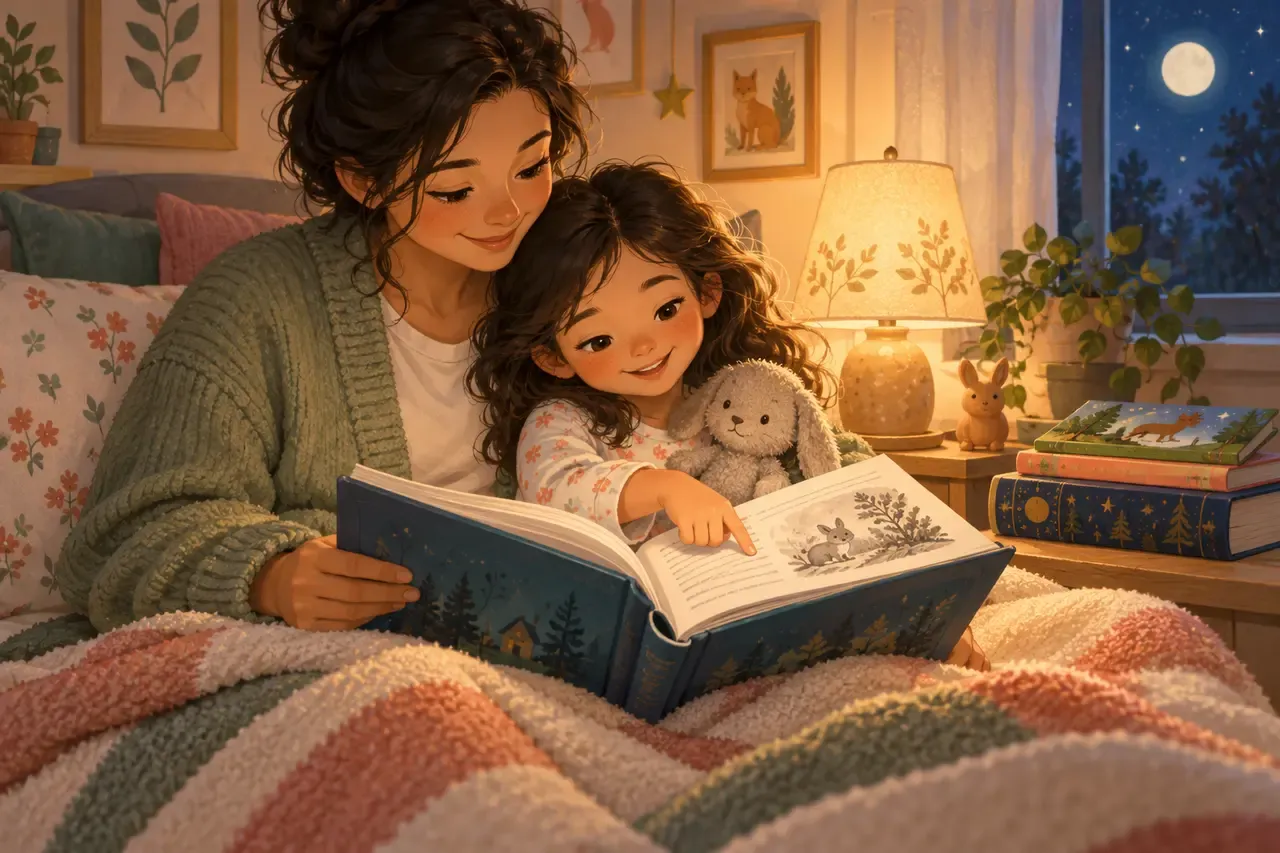
Try a chapter book when your child enjoys following a story across several sittings, rather than at a fixed birthday. Start with a short illustrated book, read a small section and see whether they want to return to it.
Keep picture books available. A longer book is another option, not a required step up a reading ladder. The guide below helps you test the format while protecting a bedtime routine your child enjoys.
What age can you start reading chapter books aloud?
Interest, listening stamina and the particular book matter more than a birthday. You can offer a short illustrated chapter as a trial whenever your child is curious about a longer story, then adjust to their response.
Reading aloud is also different from independent reading. A child can enjoy hearing a story with vocabulary and sentences beyond what they can decode alone. Reading Rockets recommends choosing read-aloud books that stretch beyond a child’s independent level while still matching their interests (Reading Rockets).
That means a child does not need to read chapter books independently before you share one at bedtime.
It also means you do not need to rush. Picture books can offer rich language, layered ideas and sophisticated art. BookTrust’s transition guidance explicitly recommends continuing to read them while trying early readers and longer books (BookTrust).
Think of chapter books as an addition to the shelf, not a replacement for everything that came before.
Five signs your child may be ready
Age can give you a rough starting point. These everyday behaviors give you better information.
1. They can remember yesterday’s story
A chapter book asks a child to carry characters, a problem and a setting from one night to the next.
Before you begin reading, casually ask, “What was happening when we stopped?” Your child does not need to give a detailed summary. Remembering one character, one funny moment or the main problem is enough to show that the story is staying with them.
If they forget, offer a two-sentence recap. Remembering a serial story is a skill that develops with practice, not an entrance exam they must pass.
2. They ask what happens next
Curiosity is one of the clearest readiness signals. A child who wonders about tomorrow’s chapter already understands the pleasure of a story continuing beyond one sitting.
Listen for questions such as:
- “Will they find the missing dog?”
- “Can we read the next bit tomorrow?”
- “Why did she hide the key?”
Those questions matter more than whether your child sits completely still. Many children listen while cuddling a toy, changing position or drawing quietly.
3. They can follow a story with fewer pictures
First chapter books do not have to be walls of text. Illustrated chapter books and early readers create a useful bridge by giving children visual anchors while asking them to imagine more of the action.
Try reading two or three pages before showing an illustration. If your child can tell who is present or what is happening, they are beginning to build the story in their mind.
If they need a picture on every page, choose a more heavily illustrated book. That is not a failure; it is useful information about the best next step.
4. They enjoy longer read-aloud sessions
If your child regularly stays engaged through several picture books, they may have enough listening stamina for a short chapter.
This does not mean bedtime reading must become longer. A ten-minute chapter can replace two ten-minute picture books. Your usual routine still sets the boundary.
If you are unsure what fits, our guide to how long a bedtime story should be offers realistic ranges and signs that a session has gone on long enough.
5. They are interested in a bigger story
The right subject can carry a child farther than a supposedly perfect reading level. A child fascinated by animals, mysteries, space or silly school adventures may listen eagerly to a longer book about that interest.
Let them help choose. Read the description together, look at a few illustrations and sample the first page. It is easier to build stamina with a story they genuinely want to hear.
Choose the right first chapter book
A successful first book is usually easier to pause than an epic adventure.
Look for:
- short chapters that can be finished in one bedtime session;
- a small cast with clearly different characters;
- a straightforward central problem;
- illustrations every few pages;
- language that sounds natural when read aloud;
- tension that is interesting without being too intense for bedtime;
- a total length that can be completed before enthusiasm fades.
Reading Rockets notes that short chapters work especially well as read-alouds and for transitional readers because each section offers movement and a reason to continue (Reading Rockets).
You may want to skim the book first. A surprise cliffhanger, frightening scene or complicated time jump can be manageable during the day but awkward five minutes before lights-out.
A low-pressure seven-night trial
You do not need to announce a permanent change. Try one book for a week and treat the result as an experiment.
Night one: keep it familiar
Begin with one short picture book, then introduce the chapter book for five minutes. Explain that the longer story will continue tomorrow.
Stopping while interest is still high can make the return feel inviting rather than frustrating.
Nights two and three: begin with a recap
Offer a simple prompt: “Yesterday we met a crow who had a difficult problem. What do you remember?”
Accept any answer, then fill in only what is needed. The recap should help the story, not turn bedtime into a quiz.
Our guide to questions after a bedtime story explains how to keep conversation open and optional.
Nights four and five: let your child steer
Ask whether they want the chapter book first or the picture book first. If they ask for another chapter, decide based on time and energy rather than creating a new rule in the moment.
“One chapter tonight, and we can continue tomorrow” is a complete answer.
Nights six and seven: notice the pattern
Is your child remembering the plot? Are they pleased to return? Does the story settle the evening or create conflict?
If the experiment is working, continue. If not, put the book away without drama and try again in a few weeks or months.
How to stop without ruining the moment
Longer stories make stopping more noticeable. A predictable closing ritual helps.
Before reading, say how you will measure the session: one chapter, ten minutes or a bookmark placed at a natural pause. Give a brief warning near the end.
Then close with three small steps:
- Name where you stopped.
- Wonder aloud about one thing that may happen next.
- Put the bookmark in together.
For example: “We stopped just as Mina found the map. I wonder where the red path leads. We will find out tomorrow.”
This gives the unfinished story a safe container. Your child does not have to hold every detail alone.
If delivery feels unfamiliar, use the same calm voice you already use. You do not need a performance; these bedtime read-aloud techniques work for both picture books and chapters.
What if they keep asking for picture books?
Keep reading them.
A preference for pictures does not mean a child is behind. The illustrations support comprehension, emotional understanding and close observation. A short book can also suit a tired night better than a continuing plot.
You can alternate formats:
- picture book on school nights, chapter book on weekends;
- one picture book followed by part of a chapter;
- chapter book for the main read-aloud, familiar picture book for the final calming minute;
- longer story at another time of day, picture book at bedtime.
Children also return to familiar stories because repetition feels good and helps them notice more. If the same favorite keeps winning, read why children want the same bedtime story before assuming they need more variety.
What if they lose track between nights?
Make the story easier to re-enter.
Use a bookmark with a small note such as “Sam entered the cave.” Ask your child to draw one event from the chapter. Keep the gap between sessions short when possible.
Scholastic recommends continuing to read aloud even after children become independent readers because listening can give them access to books they cannot yet manage alone (Scholastic).
You can do more of the memory work at first. Give names, remind them of the goal and connect the opening sentence to the previous chapter. Over time, invite your child to take over the recap if they enjoy it.
If a book needs a long explanation every night, it may simply be too complex for this moment. Choose one with fewer characters or a more episodic structure.
Signs to pause and return to picture books
Put the chapter book aside if it repeatedly leads to:
- confusion that a short recap does not resolve;
- requests to skip most of the text and look only at pictures;
- anxiety about suspense after the book is closed;
- arguments about stopping every night;
- no interest in returning after several tries;
- a bedtime session that has become noticeably too long.
The book is not lost. Readiness changes, and a few months can make a large difference.
You can also test listening with a complete story that has clear sections, such as The Crow and the Pitcher. If your child remembers the crow’s problem and solution the next day, that offers a gentle bridge toward a continuing narrative.
The best time is when the story still feels shared
Starting chapter books is not a graduation from picture books, and it is not a test of reading ability.
Try when your child can follow a story across nights, enjoys listening without constant visual support and wants to know what happens next. Begin with short illustrated chapters, keep familiar books in the routine and stop if the change makes bedtime less enjoyable.
The right first chapter book is not necessarily the easiest or the most impressive. It is the one that makes your child ask, with genuine curiosity, “Can we keep going tomorrow?”